

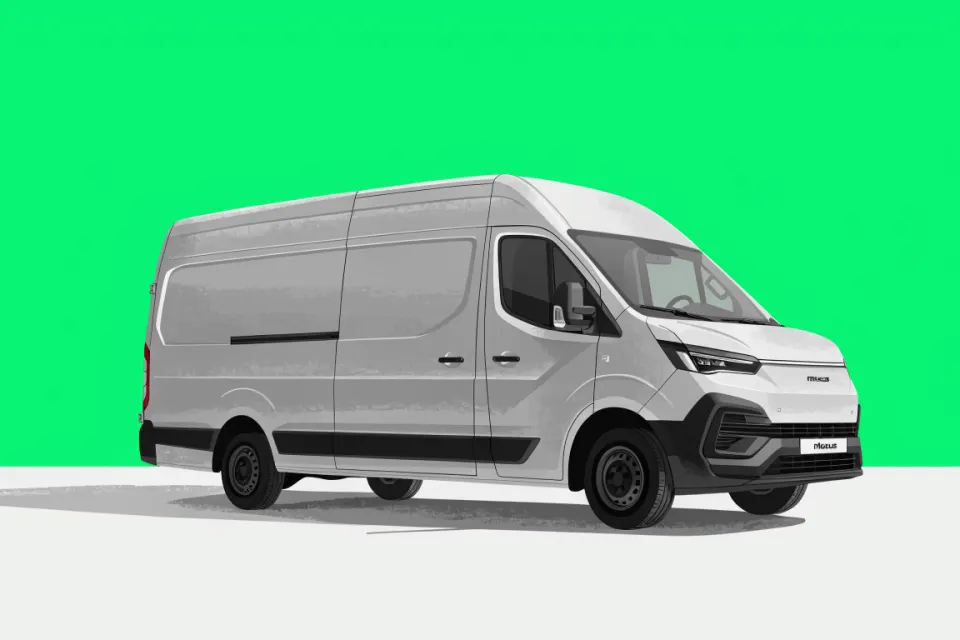
Maxus DELIVER 9 L3H2 diesel RWD
Maxus DELIVER 9 L3 H2 RWD Base
The Maxus DELIVER 9 L3 H2 RWD Base has a 150PS diesel engine, a 1,140kg payload.
Diesel · large van · L3 H2 · on sale
Dimensions
Price
| List price (excluding VAT) | Not yet verified |
|---|
Engine and economy
Load
Ownership
| Warranty | 5-year manufacturer warranty on MAXUS vehicles (the same page's 8-year HV-battery clause does not apply to this diesel model)[3] |
|---|
THRIVE verdict
A solid load-carrier with strong towing, though payload and volume trail the large-van class.
The DELIVER 9 L3 H2 RWD Base is built for everyday large-van duty: an 11m³ load bay and 1,140kg payload on a 3,500kg chassis. Both figures sit below the median for large vans in our database, so it's not the choice for operators chasing maximum cubic capacity or payload headroom, but it's still a usable size for routed delivery or trade work.
Where it does stand out is towing: 2,800kg braked puts it in the top quarter of large vans, ahead of the Renault Master E-Tech's 2,450kg and matched closely by the Volkswagen Crafter's 3,000kg. For fleets that occasionally need to pull a trailer or plant, that's a genuine point in its favour over lighter-duty rivals.
Against named diesel and electric alternatives, the picture is mixed rather than clear-cut. The Mercedes-Benz Sprinter 315 offers slightly more payload at 1,164kg but less volume at 10.5m³; the Crafter betters this van on payload at 1,229kg; the Renault Master E-Tech carries less at 1,030kg. Buyers should weigh load width of 1,800mm and height of 1,802mm against their own cargo needs, and check this van's own price once verified.
Best for
- Operators needing trailer-towing capability alongside a panel van
- General delivery and trade work within a 1,140kg payload limit
- Fleets wanting a wide load bay at 1,800mm
Think twice
- Payload is below the class median
- Load volume trails most large vans
- Price not yet verified, so total cost can't be compared directly
Written 8 October 2026 from the verified figures on this page and the rest of the THRIVE database, and checked figure by figure before publishing. How we check
Other Maxus eDeliver 9 versions
| Version | Fuel | Payload | Range / economy | Price ex VAT |
|---|---|---|---|---|
| Maxus DELIVER 9 L3H2 diesel FWD | Diesel | 1,215 kg | - | - |
| Maxus DELIVER 9 L3H3 diesel RWD | Diesel | 1,110 kg | - | - |
| Maxus DELIVER 9 L3H3 diesel FWD | Diesel | 1,200 kg | - | - |
| Maxus eDeliver 9 | Electric | 1,040 kg | 171-189 miles | - |
Every length, roof and fuel side by side, with a configurator, on the Maxus eDeliver 9 page.
What fits in the load area
| Euro pallets (1,200 x 800mm) | 4, in a single row |
|---|---|
| UK standard pallets (1,200 x 1,000mm) | 3, in a single row |
| 8 x 4 sheets (2,440 x 1,220mm) | Lie flat on the floor, between the wheel arches |
| Pipe, timber or ladders | Up to 3.4m on the floor |
Worked out from the verified floor length 3,413mm, 1,366mm between the wheel arches, 1,802mm high. At the full Euro pallet count, the payload allows about 280kg per pallet. Counts use the width between the wheel arches for the whole floor, so they never over-count. Door openings are not in our data: check the rear and side door apertures before relying on a count. Goods stacked on a pallet can stand up to about 1,652mm tall, allowing 150mm for the pallet itself.
Could you go electric?
How this van compares with Renault Master E-Tech MM35 Panel Van E-Tech Advance MY24, the closest alternative across the electric line, for a typical working day.
Electric could work: check the points below
- Range. 100 miles a day sits comfortably inside a planning range of about 178 miles, so an overnight charge covers the day.
- Payload. The electric version carries 110kg less (1,030kg against 1,140kg).
- Towing. Braked towing: 2,450kg electric, 2,800kg diesel.
- Energy. Charging at a small-business depot costs about 9.8p a mile against 20.9p for diesel: roughly £2,775 a year less at 25,000 miles.
When the diesel is the more practical choice
- Loads that use the last 110kg of the diesel's payload.
- Towing more than 2,450kg.
How this is worked out
- Planning range is 70% of the official 254-mile WLTP figure, allowing for winter weather and a full load.
- Energy use 0.343 kWh a mile: the usable battery divided by the official range.
- Diesel 165.48p a litre excluding VAT (DESNZ, week of 2 November 2026); a typical 36mpg.
- Electricity: 28.59p/kWh at a small-business depot (DESNZ, excluding VAT), 26.32p at home as the driver pays (Ofgem price cap), 65.83p on public rapid chargers (Zapmap, excluding VAT).
- 250 working days a year. List prices exclude VAT and options; running costs exclude servicing, insurance, tax and residual values.
Indicative only: a guide to whether electric is worth a closer look, not a quote. For whole-fleet costs see fleet charging costs and van break-even.
Alternatives worth considering
- Direct competitorMercedes-Benz Sprinter 315 Van L2 H2 PRO RWD0.5m³ less load space.
- Direct competitorVolkswagen Crafter Commerce, medium wheelbase with high roof, CR35, 2.0 TDI 140PS FWD 6-speed manual89kg more payload, 0.3m³ less load space.
- Electric alternativeRenault Master E-Tech MM35 Panel Van E-Tech Advance MY24Electric, 254 miles official range, 110kg less payload.
- Direct competitorMAN TGE Panel van, standard wheelbase, high roof, 2.0-litre 103kW (140PS) front-wheel drive, 6-speed manual157kg more payload, 0.3m³ more load space.
Chosen from published large vans in the THRIVE database with a similar load area; reasons compare verified figures only.
The Tuesday briefing
The week's fleet numbers and news, every Tuesday morning. Free.
One email a week. Unsubscribe in a click.
Sources
3 documents: MAXUS UK (SAIC Motor UK), Maxus UK
- MAXUS UK (SAIC Motor UK), retrieved 16 October 2026. Supports: load length (at floor), load width (maximum), load width between wheel arches, load height (maximum), overall length, overall width (excluding mirrors), overall height, co2 emissions, fuel tank, test cycle, gross vehicle weight, payload, load volume, towing capacity (braked). Maxus UK per-version spec sheet, linked as 'Spec sheet' from the saicmaxus.co.uk model page Versions carousel (undated; re-read 16 Oct 2026); page 2 'Dimensions & Capacities'. Missing on the van, documented.
- Maxus UK, retrieved 21 September 2026. Supports: engine power. Cross-checked against spec sheet: Max Power (kw / rpm) 110/3500 (110kW ≈ 150PS)
- Maxus UK, retrieved 21 September 2026. Supports: warranty.
About these figures
- Specifications verified: 16 October 2026, against the manufacturer documents listed under Sources.
- Latest source added: 16 October 2026, the last time a figure on this page was added or corrected.
- Verdict written: 8 October 2026. It uses only the verified figures here and the THRIVE database; every number in it is checked against those figures, and it is rewritten only when they change.
Specifications vary by trim, engine, battery, length and roof height; these are for the Maxus DELIVER 9 L3 H2 RWD Base as named, a typical fleet specification. Fuel economy is the official WLTP combined figure; real-world economy loaded will be lower. Check the manufacturer's current price list before ordering. If a figure here has changed, tell us on our corrections page.