

Renault Master L3H3: dimensions, payload, conversions
The Renault Master L3H3 is the long, high-roof Master: 6,315mm long, 2,780mm high, with a 3,857mm floor, 2,119mm of headroom inside and 14.8m³. Here is every dimension, the diesel and E-Tech payloads, economy and range, and what the numbers mean for racking, workshop and camper conversions.
Living guide. We check every figure against its official source and revise this page in place when a fee, rule or dataset changes. The change log at the foot records each revision.
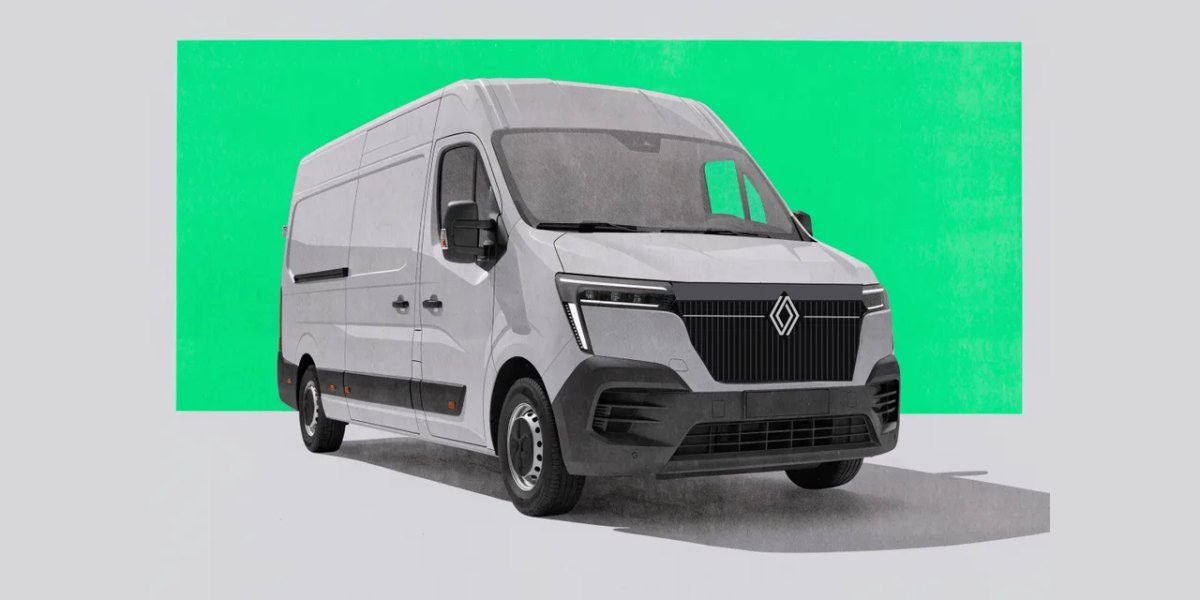
This guide covers the Renault Master L3H3 panel van, the long-wheelbase, high-roof body Renault codes LH35 (3.5 tonnes) and LH40 (4 tonnes), in diesel and E-Tech electric form, as sold in the UK. The figures come from Renault UK's Master panel van pages, its Master brochure and its LCV price guide (prices valid from 3 November 2026, the newest on Renault UK's site), with most figures held in THRIVE's van database, and were checked on 25 November 2026. Every version is on THRIVE's Renault Master page.
The short answer
- Outside: 6,315mm long (6,410mm with the rear step), 2,080mm wide without mirrors (2,466mm with them) and 2,780mm high.
- Inside: a 3,857mm load floor, 1,380mm between the wheel arches, 2,119mm of headroom (2,138mm in the E-Tech) and 14.8m³.
- Payload: Renault UK's panel van page gives 1,222kg for the L3H3 diesel, though its configurator shows 1,304kg for every 3.5-tonne diesel body, so check the plate. The E-Tech L3H3 at 3.5 tonnes carries 939kg on Renault's configurator.
- Economy and range: 36.2mpg WLTP combined for the MY27 Blue dCi 130 diesel (36.7mpg for the MY24 version Renault still lists); 242 miles WLTP from the E-Tech's 87kWh battery.
- Price: list price from £36,800 for the MY27 diesel and £45,000 for the MY27 E-Tech (before the £5,000 grant), excluding VAT, on Renault's price guide valid from 3 November 2026. The same guide still lists the MY24 diesel at £36,050 and the MY26 E-Tech at £44,250.
- Conversions: there is 2,119mm of headroom to stand in before lining, but on the Interstar twin's 1,789mm widest figure the Master is not wide enough for a 1,900mm bed across the van, and everything a conversion adds comes out of the payload. A car licence covers the diesel to 3,500kg and an electric Master to 4,250kg.
What are the Renault Master L3H3 dimensions?
The Renault Master L3H3 is 6,315mm long, 2,080mm wide without mirrors and 2,780mm high, with a 4,215mm wheelbase. Diesel and E-Tech versions share the body.
| Dimension | Master L3H3 | Source |
|---|---|---|
| Overall length | 6,315mm | Renault UK |
| Overall length with running board (rear step) | 6,410mm | Renault UK |
| Overall width without / with mirrors | 2,080mm / 2,466mm | Renault UK |
| Overall height | 2,780mm | Renault UK |
| Wheelbase | 4,215mm | Renault UK configurator |
| Front and rear overhang | 970mm and 1,130mm | Renault UK configurator |
| Load floor length | 3,857mm | Renault UK |
| Width between wheel arches | 1,380mm | Renault UK |
| Interior headroom (load height) | 2,119mm diesel, 2,138mm E-Tech | Renault UK |
| Load volume | 14.8m³ | Renault UK |
| Sliding side door entry width | 1,312mm | Renault UK |
| Rear door lower entrance width | 1,537mm | Renault UK |
| Gross vehicle weight | 3,500kg (LH35) or 4,000kg (LH40) | Renault UK brochure |
Sources: Renault UK's Master panel van and Master panel diesel pages and the Master brochure dated 1 July 2026. Renault's panel van page lists the floor as a 3,855mm "max. loading length", and its diesel configurator as a 3,857mm "load platform length"; THRIVE holds 3,857mm. Renault's configurator also gives an "unladen height" of 2,756mm alongside the 2,780mm overall height. Renault does not publish the load width at the widest point or the side door height for the Master; its twin, the Nissan Interstar L3H3, is listed by Nissan at 1,789mm wide at the widest point, with a side door opening 1,753mm high and rear doors 1,755mm high.
6,315mm or 6,410mm: the rear step
The Master and the Interstar can appear as 6,315mm and 6,410mm long because one figure includes the rear step and the other does not. The Nissan Interstar is the Master's twin, with the same 3,855mm floor, 1,380mm between the arches and 14.8m³. THRIVE's database holds Renault's 6,315mm body length for the Master and Nissan's 6,410mm for the Interstar, and Renault's own panel van page lists both: 6,315mm overall, and 6,410mm "with running board". Nissan's dimensions page does the same, giving 6,315mm and 6,410mm "with rear step bumper". The vans are the same length; for a parking bay or a workshop door, use 6,410mm if a step is fitted.
Height barriers
At 2,780mm, a Master L3H3 will not fit under a 2.1m car park height barrier; any barrier has to clear 2,780mm plus whatever is on the roof. In THRIVE's database only one large van version with a published height, the Farizon SV L1H1, is under 2.1m, as the van sizes guide shows. If the van has to use height-restricted sites, the 2,500mm L3H2 is 280mm lower, though still well over 2.1m.
What is the payload of a Renault Master L3H3?
Renault UK gives the Master L3H3 diesel a payload of 1,222kg, on its panel van page, the only Renault figure published for that body alone. The E-Tech electric L3H3 at 3,500kg carries 939kg, on Renault's configurator. Payload is the gross vehicle weight less the van's own weight, so options, racking and a conversion all reduce it.
| Master panel van (3.5t) | Payload | Braked towing |
|---|---|---|
| L2H2 diesel | 1,304kg | 2,500kg |
| L3H2 diesel | 1,232kg | 2,500kg |
| L3H3 diesel | 1,222kg | 2,500kg |
| L2H2 E-Tech | 1,030kg | 2,450kg |
| L3H2 E-Tech | 959kg | 2,300kg |
| L3H3 E-Tech | 939kg | 2,350kg |
Sources: diesel payloads from Renault UK's panel van page; E-Tech payloads and towing from Renault UK's E-Tech configurator; diesel towing from the Master brochure. Renault's own figures conflict, so treat these as a guide. Its diesel configurator shows 1,304kg for every 3.5-tonne diesel body, L2H2, L3H2 and L3H3 alike, with kerb weight "tbc"; THRIVE uses the body-by-body figures on the panel van page instead, though that page does not state the gross weight they apply to and still marks the L3H3 column "available at a later date". Nissan's 3.5-tonne Interstar L3H3 twin is listed at 1,233kg, close to Renault's 1,222kg. The brochure gives a "max payload" of 1,488kg for L3H3 versions, which can only be the 4-tonne LH40: 3,500kg less the lightest L3H3 kerb weight in the same table, 2,203kg, is 1,297kg. For the E-Tech, Renault's current MY27 page shows 1,016kg against a gross weight of "3500 - 4000", and the panel van page lists 1,327kg; THRIVE holds the 939kg that Renault's configurator gave for the 3.5-tonne version. Check the payload on the plate of the van you are buying, and weigh a converted van.
The diesel's gross train weight is 6,000kg, so a fully laden 3,500kg van can pull the full 2,500kg braked trailer. THRIVE's large diesel vans by payload list has the full ranking.
Euro pallets in a Master L3H3
Four 1,200 x 800mm Euro pallets, or three 1,200 x 1,000mm pallets, on THRIVE's calculation. The 1,380mm between the arches takes one pallet across, but not two side by side, which would need 1,600mm. Across the van each Euro pallet uses 800mm of floor, and 3,857mm takes four rows (3,200mm) with 657mm spare; a fifth would need 4,000mm. For the 1,200 x 1,000mm size, three rows use 3,000mm, or 3,200mm with one turned lengthways, and a fourth does not fit. These are THRIVE's counts from Renault's floor length and arch width, made by the method in the van sizes guide, not a Renault claim. The 1,312mm side door takes a 1,200mm pallet edge on.
Renault Master L3H3 or L3H2: what is the difference?
Only the roof. The L3H2 and L3H3 share the 6,315mm length, the 3,857mm floor and the 1,380mm between the arches; the L3H3 adds 234mm of headroom inside and 1.8m³ of volume, for £1,000 more on list and, on Renault's panel van page, 10kg less payload.
| Diesel, Blue dCi 130 Advance (MY27) | L3H2 | L3H3 |
|---|---|---|
| Overall height | 2,500mm | 2,780mm |
| Interior headroom | 1,885mm | 2,119mm |
| Load volume | 13m³ | 14.8m³ |
| Payload | 1,232kg | 1,222kg |
| WLTP combined | 37.2mpg | 36.2mpg |
| List price ex VAT | £35,800 | £36,800 |
Sources: Renault UK panel van page and diesel configurator, and the MY27 rows of Renault's LCV price guide valid from 3 November 2026. The same guide still lists the MY26 L3H2 at £35,050 and 37.7mpg and the MY24 L3H3 at £36,050 and 36.7mpg, also £1,000 apart. THRIVE's reading: the H2 suits loads that do not need the height and vans that use height-restricted sites; the H3 suits anyone who has to stand up inside, tall loads and most conversions. Before any lining, 1,885mm is tight for a tall adult to stand in; 2,119mm gives 234mm more.
What MPG does a Renault Master do?
The Renault Master L3H3 Blue dCi 130 diesel is listed at 36.2mpg on the WLTP combined cycle, with CO2 of 204g/km, in its MY27 form on Renault UK's LCV price guide valid from 3 November 2026. In the same guide the MY27 L2H2 is listed at 37.7mpg, the L3H2 at 37.2mpg and the L3H3 Blue dCi 150 Heavy Duty at 22.1mpg and 336g/km. The guide also still lists the MY24 L3H3 Blue dCi 130 at 36.7mpg and 202g/km. Renault says WLTP figures are for comparability and real-world results vary with weather, driving style, vehicle load and accessories; real-world economy is usually lower.
At the DESNZ pump price for the week of 23 November 2026 (diesel 193.29p a litre, including VAT), 36.2mpg is 24.3p a mile and 36.7mpg is 23.9p a mile at the official economy, on THRIVE's arithmetic. That is better on paper than the 30.4mpg of the Citroën Relay, Peugeot Boxer and Fiat Ducato L3H3, the 31.7mpg of the Ford Transit L3H3 and the 34.4mpg of the Toyota Proace Max L3H3. Run your own mileage on the fleet fuel calculator, and compare large vans on the most economical large vans list.
How far does the Master E-Tech L3H3 go on a charge?
242 miles on the WLTP cycle, Renault says, for the E-Tech L3H3 at 3.5 tonnes with its 87kWh usable battery. The L2H2 is listed at 254 miles and the L3H2 at 252. Renault's headline "up to 285 miles" is for the 4-tonne L2H2, and its current L3H3 E-Tech page shows 285 miles in one panel and 242 miles in the version's WLTP data; THRIVE holds 242.
- Charging: up to 130kW DC and 22kW AC; Renault quotes 15% to 80% in 38 minutes on a 130kW DC charger, measured on the 4-tonne L2H2.
- Payload: 939kg at 3.5 tonnes, 283kg less than the diesel L3H3.
- Price: £45,000 list excluding VAT for the MY27 LH35, before the £5,000 zero emission van grant, on the price guide valid from 3 November 2026; the MY26 version is still listed at £44,250. The 4-tonne LH40 E-Tech is listed at £48,000 (MY27) or £47,250 (MY26).
- Running cost: at THRIVE's standard 0.35kWh a mile, 9.2p a mile at the Ofgem price cap and 28.7p on a Zapmap rapid charger, against 24.3p for the MY27 diesel. Renault's 87kWh and 242 miles imply about 0.36kWh a mile before charging losses.
Sources: Renault UK E-Tech configurator and pages, brochure and price guide; GOV.UK's grant list, which includes the "Renault Master E-Tech (panel and conversions)". For how it ranks, see large electric vans, the largest electric vans by load volume and THRIVE's electric van buying guide.
Suitability for conversions
The L3H3 is strong on headroom and floor length; on width and payload, the numbers need checking first. This section is THRIVE's reading of Renault's dimensions against common conversion needs. It is not Renault guidance.
Can you stand up in a Renault Master L3H3?
Most adults can: Renault gives 2,119mm of interior headroom in the diesel and 2,138mm in the E-Tech, measured in the bare van. A floor, insulation and a ceiling lining each take some of that, so the finished headroom will be lower, by however much the converter builds in. The L3H2's 1,885mm leaves far less room once a floor and ceiling go in.
Will a bed fit across a Renault Master L3H3?
Not at full length. THRIVE works on 1,900mm as the length of a bed an adult can lie flat on. Between the wheel arches the Master is 1,380mm wide, 520mm short of that; at the widest point, which Nissan gives as 1,789mm for the Interstar twin, it is still 111mm short. A bed across the van needs a shorter bed or side extensions fitted by a converter. Lengthways, a 1,900mm bed on the 3,857mm floor leaves 1,957mm for everything else. None of the L3H3 vans in THRIVE's database is 1,900mm wide inside: the widest, the Citroën Relay, Peugeot Boxer, Fiat Ducato, Vauxhall Movano and Toyota Proace Max, are 1,870mm at the widest point.
Payload after a conversion, and the 3.5 tonne limit
Everything a conversion adds, from racking and ply lining to a bed, water, a leisure battery and a heater, comes out of the payload, along with the driver and passengers. A diesel L3H3 at 1,222kg has more to give than the E-Tech at 939kg. The limit is the plated gross weight: a diesel Master LH35 cannot be loaded past 3,500kg. Weigh the finished van, loaded as it will work, at a public weighbridge.
The licence follows the same weight. GOV.UK's driving licence categories page says a category B licence covers petrol, diesel and hybrid vehicles up to 3,500kg maximum authorised mass, and electric or hydrogen vehicles up to 4,250kg, "zero emission vehicles only". GOV.UK's guidance on driving an electric or hydrogen-powered vehicle, which applies to England, Scotland and Wales, adds that the trailer must never exceed 3,500kg and the combination 7,000kg, and points to providers of specialist training for 3,500kg to 4,250kg zero emission goods vehicles. So a car-licence driver can drive the 4-tonne E-Tech LH40; a diesel above 3,500kg needs a higher category. Heavier electric vans have other rules, covered in THRIVE's guide to tachographs for vans, and employers checking licences should see driving licence checks for employers.
Racking, workshops and roof loads
Renault says its "certified converter partners" provide "everything from lining to racking", through its Renault Pro+ retailers, on its conversions page. The same page describes a "modul system" app for workshop vehicles that "calculates and alerts you about the load on board", and a Converter Companion that brings a conversion's functions into the Master's openR Link screen. The Master brochure says Renault works with "over 40 certified converters in the UK", from refrigerated vans to horseboxes, as well as its own conversion facility at the Batilly plant.
For racking, the 1,312mm sliding door and 1,537mm rear opening are what matter for getting long items in. On the roof, Renault's UK pages checked for this guide publish no maximum roof load for the Master; its brochure offers an aluminium roof rack that "can carry up to 150 kg", without saying which roof heights it fits. Nissan lists the Interstar L3H3 twin with a maximum roof load of 0kg, against 200kg for the L3H2, so ask Renault before planning a roof rack or ladder rack on an L3H3.
Motorhome conversions
A converted van can be re-registered as a motor caravan, but the DVLA decides. Its guidance on converting a vehicle into a motor caravan (updated 6 November 2026) requires seats and a table, sleeping accommodation, cooking facilities and storage, fixed to the vehicle, and says DVLA considers external features: two or more windows on at least one side of the main body, a separate door to the living area, and a high-top or pop-top roof. A van can still be used as a motor caravan without the body type change if it meets the internal requirements, the guidance says.
How does the Master L3H3 compare with other L3H3 vans?
The Master and Interstar have the longest floor of the L3H3 vans in THRIVE's database, at 3,855mm to 3,857mm, but less headroom than the Interstar, the Transit or the Stellantis-built vans.
| L3H3 diesel panel van | Floor x between arches | Headroom | Volume | Payload | WLTP | List from, ex VAT |
|---|---|---|---|---|---|---|
| Renault Master | 3,857 x 1,380mm | 2,119mm | 14.8m³ | 1,222kg | 36.2mpg | £36,800 |
| Nissan Interstar | 3,855 x 1,380mm | 2,138mm | 14.8m³ | 1,233kg | 36.2mpg | £36,490 |
| Ford Transit | 3,533 x 1,392mm | 2,125mm | 13m³ | 1,380kg | 31.7mpg | £49,845 |
| Citroën Relay, Peugeot Boxer, Fiat Ducato | 3,705 x 1,422mm | 2,172mm | 15m³ | 1,350kg | 30.4mpg | £35,665 |
| Vauxhall Movano | 3,705 x 1,422mm | 2,172mm | 15m³ | 1,350kg | 30.4mpg | £36,565 |
| Toyota Proace Max | 3,705mm (arches not published) | 2,172mm | 15m³ | 1,400kg | 34.4mpg | £36,462 |
| Maxus Deliver 9 (FWD) | 3,413 x 1,366mm | 2,112mm | 12.9m³ | 1,200kg | Not published | Not published |
Source: THRIVE's van database, manufacturers' figures, read 25 November 2026; Master payload from Renault UK's panel van page, and Master economy and price from the MY27 row of Renault's price guide valid from 3 November 2026 (the MY24 is listed at 36.7mpg and £36,050). Versions and trims differ, so compare quotes like for like. THRIVE's database holds no L3H3 version of the Mercedes-Benz Sprinter or VW Crafter; their L3H2 bodies are longer, with 4,410mm and 4,300mm floors, 2,009mm and 1,961mm of headroom and list prices from £51,420 and £43,135, on the Sprinter and Crafter pages.
THRIVE's reading: the Master's case is the longest L3H3 floor, shared with the Interstar, and official economy level with the Interstar and better than the Relay group, the Proace Max or the Transit, at a MY27 list price £1,135 above the cheapest here, the Relay, Boxer and Ducato. Against it, the Relay, Boxer, Ducato and Movano give 53mm more headroom, 42mm more between the arches and 128kg more payload, the Proace Max carries 178kg more, and the Transit 158kg more. Head-to-head pages: Transit v Master, Master v Movano, Ducato v Master and Master v Proace Max. Electric rivals at L3H3 include the Ford E-Transit (865kg, 152 miles WLTP), the Toyota Proace Max Electric (plated at 4,250kg, 1,435kg, 260 miles) and the Farizon SV (1,045kg, 204 miles). For load space across all sizes, see diesel vans by load volume.
About this guide
Dimensions, payloads, towing and range are Renault UK's, from its Master panel van, diesel and E-Tech pages and configurators, its Master brochure dated 1 July 2026 and its LCV price guide valid from 3 November 2026, as held in THRIVE's van database and checked on 25 November 2026. Where Renault does not publish a figure, the Nissan Interstar twin's figure from Nissan UK is given and labelled. Rival figures are their makers', from THRIVE's database. Licence and motor caravan rules are from GOV.UK and DVLA. Pallet counts, bed geometry, pence-per-mile figures and the comparisons are THRIVE's own arithmetic, not manufacturers' claims; fuel and electricity prices are from DESNZ, Ofgem and Zapmap.
Out of scope: chassis cabs, Luton and tipper versions, crew vans, conversion prices and lease rates. THRIVE will review this guide when Renault's price guide or Master specifications change, and by 6 April 2027 at the latest.
Free to quote and cite with a link to this page. Suggested citation:
THRIVE, "Renault Master L3H3: dimensions, payload, conversions", reviewed 25 Nov 2026. https://www.thrivefleet.co.uk/guides/renault-master-l3h3-dimensions-payload
Sources
Renault UK: Master panel van - Payload capacity L2H2 1,304kg, L3H2 1,232kg, L3H3 1,222kg (diesel, gross weight not stated; L3H3 column marked available at a later date); E-Tech row 1,327kg for L3H3; 6,315mm and 6,410mm with running board; 2,780mm high; 1,380mm between arches; 1,312mm side door; 1,537mm rear door. Checked 25 November 2026.Renault UK: Master panel diesel - LH35 Blue dCi 130 Advance: 3,857mm load platform, 2,119mm interior headroom, 2,780mm overall height, 4,215mm wheelbase, 6,000kg gross train weight; configurator payload 1,304kg shown for every body with kerb weight tbc. Checked 25 November 2026.Renault UK: Master E-Tech panel van and configurator - LH35 E-Tech: 2,138mm headroom, 242 miles WLTP in the version data (285 in one panel), 939kg payload at 3.5t as held in THRIVE's database (current MY27 page shows 1,016kg at 3,500 to 4,000kg), 2,350kg towing. Checked 25 November 2026.Renault UK: Master and Master E-Tech brochure (1 July 2026) - 14.8m³; GVW 3,500 or 4,000kg; L3H3 kerb weight 2,203 to 2,512kg and max payload 1,488kg; roof rack up to 150kg; 2.5 tonnes towing; Batilly conversion facility; over 40 certified UK converters. Checked 25 November 2026.Renault UK: LCV price guide (prices valid from 3 November 2026) - Newest Renault UK price guide. Master list prices, WLTP mpg and CO2: LH35 Blue dCi 130 MY27 £36,800, 36.2mpg, 204g/km (MY24 £36,050, 36.7mpg, still listed); LM35 MY27 £35,800, 37.2mpg; Heavy Duty 22.1mpg; LH35 E-Tech MY27 £45,000 (MY26 £44,250), LH40 MY27 £48,000; £5,000 ZEVG. Checked 25 November 2026.Renault UK: Conversions - Certified converter partners, lining to racking, refrigerated bodies, modul system app for workshop vehicles, Converter Companion. Checked 25 November 2026.Nissan UK: Interstar dimensions - Interstar L3H3: 6,315mm and 6,410mm with rear step bumper; 1,789mm widest; side door 1,753mm high; rear doors 1,755mm high; payload 1,233kg; max roof load 0kg (L3H2 200kg). Checked 25 November 2026.GOV.UK: Driving licence categories - Category B: 3,500kg MAM for petrol, diesel and hybrid; up to 4,250kg for zero-emission electric and hydrogen vehicles. Checked 25 November 2026.GOV.UK: Driving an electric or hydrogen powered vehicle - Up to 4,250kg on category B; trailer up to 3,500kg and combination up to 7,000kg; specialist training providers; England, Scotland and Wales. Updated 10 June 2025. Checked 25 November 2026.DVLA: Converting a vehicle into a motor caravan - Internal features required and external features considered for a body type change. Updated 6 November 2026. Checked 25 November 2026.GOV.UK: Zero emission vehicles eligible for a grant, vans - Large vans 2,500kg to 4,250kg up to £5,000; Renault Master E-Tech (panel and conversions) listed. Checked 25 November 2026.DESNZ: Weekly road fuel prices - Diesel 193.29p a litre, week of 23 November 2026. Checked 25 November 2026.Ofgem: Energy price cap unit rates - Electricity 26.32p/kWh from 1 October 2026. Checked 25 November 2026.Zapmap: Charging price index - Rapid 82p/kWh, October 2026 index. Checked 25 November 2026.THRIVE: Renault Master - Every Master version in THRIVE's van database, with sources.THRIVE: Van sizes explained - THRIVE guide: size classes, pallet method and height barriers.THRIVE: Large diesel vans by payload - The full, live ranking.- : First edition.
Spotted something out of date? hello@thrivefleet.co.uk or our corrections page.