

THRIVE Intelligence · Analysis
Electric van charging costs: what each van costs a mile, from depot to rapid charger
THRIVE priced 11 electric vans on their official energy use. Charged at a depot they cost 8p to 15p a mile, below the most economical diesel of their size in every case. On public rapid chargers they cost 19p to 35p before VAT, more than the best diesel in every case.
Fleet charging costs: depot, home or public
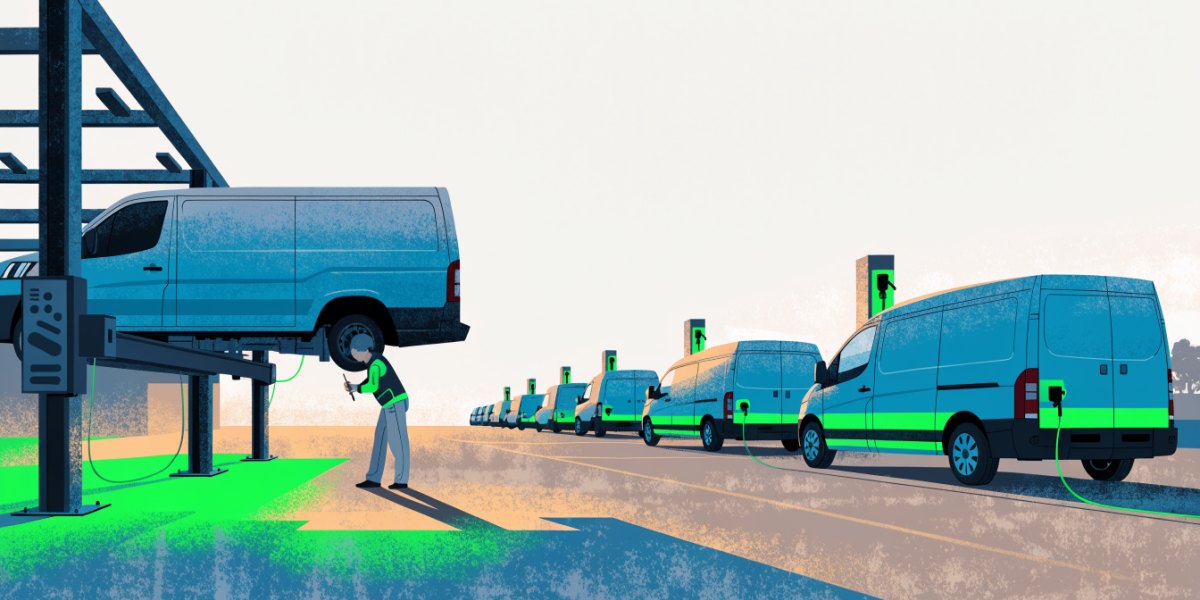
Charging an electric van at a business depot costs between 8p and 15p a mile in energy, depending on the van, at the average price small businesses paid for electricity in the second quarter of 2026. That is below the fuel cost of the most economical diesel van in every size class. On a public rapid charger the same vans cost between 19p and 35p a mile before VAT, more than the best diesel in every case THRIVE checked.
Where a van charges matters more than which van it is. THRIVE priced 11 electric vans on sale in the UK, from the small Ford E-Transit Courier to the 4.25-tonne Fiat E-Ducato, using each maker's official energy-use figure and the prices in THRIVE's charging data. The Ford E-Transit Custom costs 9.4p a mile charged at home, 10.2p at a depot and 23.5p on a public rapid charger, against 17.8p for the most economical medium diesel van.
Electric van charging costs at a glance
- Depot: 28.6p a kWh for a business using 20 to 499 MWh a year, before VAT (DESNZ, April to June 2026). Smaller users paid 38.4p.
- Home: 26.3p a kWh under the Ofgem price cap from 1 October 2026, with no VAT on household electricity in Great Britain until 30 June 2027.
- Public: 54p a kWh on standard chargers and 79p on rapid chargers including VAT (Zapmap's index as held in THRIVE's data and cited by the government's charging review); 45.0p and 65.8p before VAT. Zapmap's October index put rapid charging at 82p.
- VAT: public and workplace charging is standard-rated at 20%, written into law from 1 November 2026.
- Per mile: 8p to 15p at the depot, 19p to 35p on rapid chargers, for the vans in THRIVE's comparison.
What each van costs a mile to charge
An electric van's running cost is its energy use multiplied by the price of electricity. The table uses each maker's official WLTP energy-use figure, as recorded in THRIVE's van database; for the Fiat, Citroën and Peugeot large vans the maker describes it as a calculated WLTP figure. Where a maker publishes a range, the table uses the higher-consumption end, as THRIVE's van lists do. Ford gives one range, 30.1 to 33.0 kWh/100km, for all E-Transit 350 standard-range bodies, and the table uses 33.0. Ford's price list gives the E-Transit Courier both 17.7 kWh/100km and 4.4 miles a kWh, which do not agree; the table uses the first, which is the more cautious (Ford's 4.4 miles a kWh would give 6.5p a mile at the depot rather than 8.1p).
| Van | Official energy use | Depot | Home | Public standard | Public rapid | Best diesel in class |
|---|---|---|---|---|---|---|
| Ford E-Transit Courier | 3.51 miles/kWh | 8.1p | 7.5p | 12.8p | 18.8p | 14.1p |
| Peugeot E-Partner M | 2.86 miles/kWh | 10.0p | 9.2p | 15.7p | 23.0p | 14.1p |
| Volkswagen ID. Buzz Cargo | 2.90 miles/kWh | 9.9p | 9.1p | 15.5p | 22.7p | 17.8p |
| Ford E-Transit Custom L1H1 | 2.80 miles/kWh | 10.2p | 9.4p | 16.1p | 23.5p | 17.8p |
| Toyota Proace Electric Medium | 2.61 miles/kWh | 11.0p | 10.1p | 17.2p | 25.2p | 17.8p |
| Citroën ë-Dispatch M | 2.35 miles/kWh | 12.1p | 11.2p | 19.1p | 28.0p | 17.8p |
| Mercedes-Benz eVito L2 | 2.35 miles/kWh | 12.1p | 11.2p | 19.1p | 28.0p | 17.8p |
| Fiat E-Ducato L3H2 4.25t | 2.37 miles/kWh | 12.1p | 11.1p | 19.0p | 27.8p | 19.7p |
| Citroën ë-Relay L4H3 4.25t | 2.28 miles/kWh | 12.6p | 11.6p | 19.8p | 28.9p | 19.7p |
| Citroën ë-Relay L3H2 3.5t | 2.11 miles/kWh | 13.5p | 12.5p | 21.3p | 31.1p | 19.7p |
| Ford E-Transit 350 L2H2 | 1.88 miles/kWh | 15.2p | 14.0p | 23.9p | 35.0p | 19.7p |
The prices before VAT are what a VAT-registered business pays after reclaiming it. Home charging is shown at the household price cap, which carries no VAT at the moment. The diesel column is the fuel cost of the most economical diesel van of the same size in THRIVE's diesel van ranking, at the UK average diesel price for the week of 2 November 2026, 198.6p a litre, or 165.5p before VAT.
One pair needs a caution. The 4.25-tonne Fiat E-Ducato L3H2 shows lower energy use than the 3.5-tonne Citroën ë-Relay L3H2, although both list a 97.8kWh battery. Both figures are the makers' calculated WLTP values for that weight rating; THRIVE has not found an explanation for the difference, so treat a gap of that size between such similar vans with care.
Three things stand out.
- At the depot or at home, every van beats diesel. The widest gap is the Volkswagen ID. Buzz Cargo: 9.9p a mile at the depot against 17.8p for the best medium diesel.
- On rapid chargers, none does. All 11 cost more a mile on public rapid charging than the most economical diesel in their class. A van that relies on rapid charging loses the energy saving entirely.
- The large Ford E-Transit uses the most energy. On Ford's cautious figure it covers 1.9 miles on a kWh, against 3.5 miles for the E-Transit Courier, so at the depot it costs 15.2p a mile against the Courier's 8.1p.
Ford E-Transit Custom: pence a mile by where it charges
Official WLTP energy use, prices before VAT; diesel is the most economical medium diesel van
Show the figures as a table
| Home | 9.4p |
|---|---|
| Depot | 10.2p |
| Public standard | 16.1p |
| Diesel (Renault Trafic) | 17.8p |
| Public rapid | 23.5p |
What a full battery costs
Drivers and managers often think in terms of a full charge. The table below prices each van's battery capacity as listed in THRIVE's database. Charging loses some energy between the socket and the battery, so the bill for a real charge from empty will be somewhat higher. Battery capacity is as each maker lists it; some quote gross capacity and some usable, so the figures are not strictly comparable between makers.
| Van | Battery, as listed | Depot | Home | Public rapid |
|---|---|---|---|---|
| Ford E-Transit Courier | 46.0kWh | £13.15 | £12.11 | £30.28 |
| Peugeot E-Partner M | 50.7kWh | £14.50 | £13.34 | £33.38 |
| Volkswagen ID. Buzz Cargo | 79.0kWh | £22.59 | £20.79 | £52.01 |
| Ford E-Transit Custom L1H1 | 71.0kWh | £20.30 | £18.69 | £46.74 |
| Toyota Proace Electric Medium | 69.0kWh | £19.73 | £18.16 | £45.43 |
| Citroën ë-Dispatch M | 69.0kWh | £19.73 | £18.16 | £45.43 |
| Mercedes-Benz eVito L2 | 60.0kWh | £17.15 | £15.79 | £39.50 |
| Fiat E-Ducato L3H2 4.25t | 97.8kWh | £27.96 | £25.74 | £64.39 |
| Citroën ë-Relay L4H3 4.25t | 97.8kWh | £27.96 | £25.74 | £64.39 |
| Citroën ë-Relay L3H2 3.5t | 97.8kWh | £27.96 | £25.74 | £64.39 |
| Ford E-Transit 350 L2H2 | 68.0kWh | £19.44 | £17.90 | £44.77 |
The Public Charge Point Regulations 2023 require public charge point operators to display the total price in pence per kilowatt hour, and the government's charging review recommends that they also show the cost of a full charge.
Depot charging: the cheapest, with conditions
Business electricity is not covered by the Ofgem price cap. The Department for Energy Security and Net Zero publishes what businesses actually pay, by how much electricity they use in a year. In April to June 2026, including the Climate Change Levy and excluding VAT:
- up to 20 MWh a year: 38.4p a kWh;
- 20 to 499 MWh: 28.6p;
- 2,000 to 19,999 MWh: 25.2p.
The band depends on the whole site's use, not just the vans. A medium electric van covering 18,000 miles a year uses several MWh, so a small business adding a handful of vans to a modest supply may sit in the smallest band and pay a third more than the table shows. A larger depot that already uses a lot of electricity may pay less. These prices exclude standing and capacity charges, and installing chargers, and possibly a bigger grid connection, is a separate cost. THRIVE's fleet charging costs page works out the band and the depot charger payback for a fleet of any size.
Two government grants can help with installation. The Workplace Charging Scheme pays up to £500 a socket, up to 75% of the cost, for up to 40 sockets, for charge points used by staff or fleet vehicles; it is open until 31 March 2027. The Depot Charging Scheme, for vans, coaches and electric lorries, was given a further £170 million in March 2026 and covered up to 70% of costs, up to £1 million per organisation, in its first funding window; rates for later windows may differ, so check before applying. The Budget of November 2025 also announced a 100% business rates relief for eligible charge points in England, until 2036. It is for properties that consist wholly or mainly of charge points and bays open to customers, so bays inside a larger depot are unlikely to qualify.
Home charging: cheap, but who pays?
A van taken home and charged on a household supply pays the domestic price. Under the Ofgem cap from 1 October to 31 December 2026, that is 26.32p a kWh on average for Direct Debit customers, plus a daily standing charge. VAT on household electricity in Great Britain was cut from 5% to zero from 1 October 2026, and the Budget extended the zero rate to 30 June 2027, HMRC says. Ofgem had not announced the cap for January to March 2027 when this article was written.
The difficulty is reimbursement. HMRC publishes advisory electric rates for company cars, 7p a mile for home charging and 15p for public charging from 1 September 2026, but they apply to cars only, and are based on a car's efficiency. There is no equivalent official rate for vans. On the figures used here, every van in the table costs more than 7p a mile to charge at the cap price, so an employer that borrows the car rate for vans will under-pay drivers on these figures. Measuring the van's actual charging energy, through the charger or the van's own telematics, avoids the problem.
Public charging: the price of convenience
The government's independent review of the cost of public charging, published on 28 October 2026, found that average prices at lower-powered public chargers have risen by 69% in real terms since 2021, and at rapid chargers by 94%. Using Zapmap's price index, it gives average tariffs of 54p a kWh on standard chargers and 79p on rapid chargers. Zapmap's October 2026 index put rapid charging at 82p. THRIVE uses the review's 79p so that its figures match the government's; at 82p the rapid column rises by about 4%.
Those prices include 20% VAT. HMRC's position has been that public charging is standard-rated, and after a tribunal challenge the Budget put that in law: from 1 November 2026 the law treats charging at public and workplace charge points as not for domestic use, so it is standard-rated, according to HMRC's Revenue and Customs Brief 13 (2026). A VAT-registered business can normally reclaim it, which is why the table shows public prices before VAT.
The review made five recommendations, including piloting "tariff porting", which would let drivers use their own energy tariff at certain public chargers, and time-limited support to cut prices. It noted that tariff porting could have applications for fleets and company cars. The government responded with £100 million over two years from spring 2027 to cut prices at lower-powered public chargers on residential streets, and an industry taskforce on tariff porting. The money is aimed at drivers without off-street parking, not at fleet depots, and the Department for Transport has not yet said how it will be delivered.
The mix decides the bill
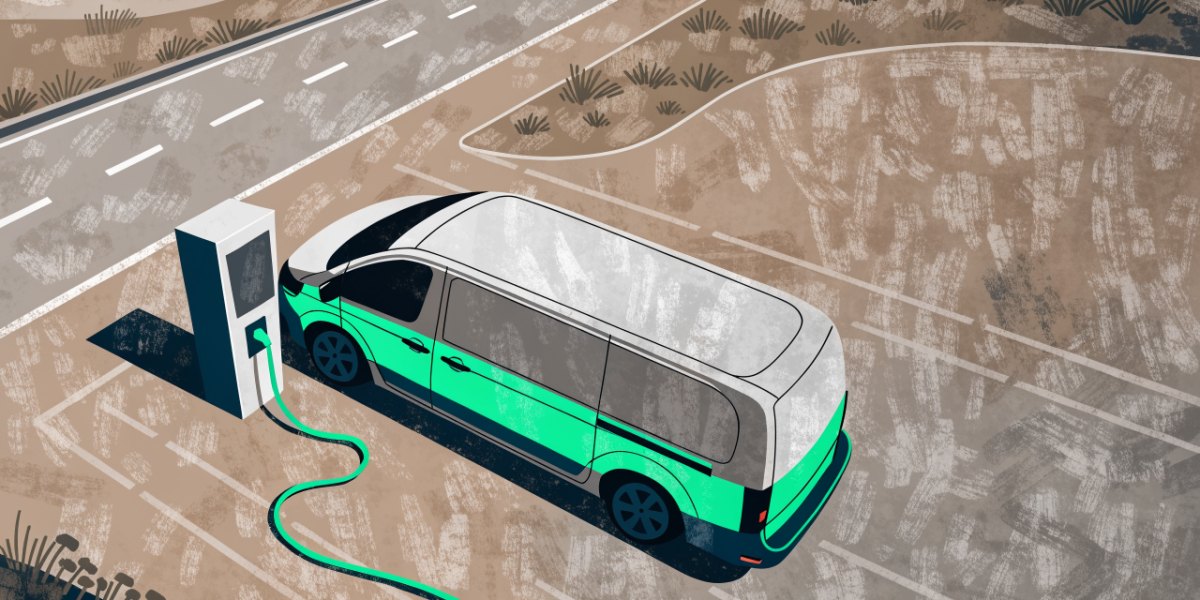
Few vans charge in only one place. The useful question for a fleet is what share of its miles come from each source. For the E-Transit Custom, charging 70% at the depot and 30% on public standard chargers works out at about 12p a mile; switching that 30% to rapid chargers takes it to about 14p. Both are below the 17.8p of the most economical medium diesel, but the margin shrinks from about 6p to under 4p a mile when the public share moves to rapid chargers. The van break-even shows how that margin turns into the mileage at which an electric van's higher price is repaid.
Taxes on the electric van itself
- Pay-per-mile duty: Electric Vehicle Excise Duty, due from 1 April 2028 at 3p a mile, subject to legislation in the Finance Bill 2026-27, applies to cars only when it starts. The government's consultation response says vans will be out of scope.
- Road tax: most electric vans have paid the standard van rate since 1 April 2025.
- Company van tax: an electric van has a nil van benefit charge for an employee who uses it privately, as long as it counts as a van for this tax. A van over 3,500kg, such as the two 4.25-tonne vans in the table, does not. See THRIVE's guide to company van tax in 2027/28.
- Van grant: up to £2,500 off small electric vans and up to £5,000 off large ones, on the government's plug-in van grant.
Questions fleets are asking
How much does it cost to charge an electric van?
For the 11 vans THRIVE checked, 8p to 15p a mile at a business depot, 7.5p to 14p at home under the price cap, and 19p to 35p on public rapid chargers before VAT. A full battery costs from about £13 to £28 at a depot.
Is it cheaper to run an electric van than a diesel?
On energy, yes, if it charges at a depot or at home: every van in THRIVE's comparison costs less a mile than the most economical diesel of its size. On public rapid chargers, no: every one costs more.
Is there VAT on electric van charging?
Public and workplace charging is charged at 20%, which a VAT-registered business can normally reclaim. Household electricity, including home charging, carries no VAT in Great Britain until 30 June 2027. The extension to that date is due to be made by secondary legislation in early 2027.
What rate should I pay a van driver for charging at home?
HMRC has no advisory rate for vans; its 7p a mile home rate is for company cars. At the current price cap, every van in THRIVE's comparison costs more than 7p a mile to charge at home on the figures used, so employers can reimburse the measured energy instead.
Will electric vans pay pay-per-mile tax?
Not when it starts, which is planned for 1 April 2028. The government says vans will be out of scope of Electric Vehicle Excise Duty at introduction.
How we did this
This is a THRIVE Intelligence analysis. Prices come from the official and industry sources below, as held in THRIVE's data tables; each van's energy use is its manufacturer's official figure. Costs were calculated in code.
Primary documents
- DESNZ: gas and electricity prices in the non-domestic sector (Quarterly Energy Prices, table 3.4.2)
- Ofgem: energy price cap rates
- Zapmap Price Index (commercial index of public charging prices)
- DESNZ: weekly road fuel prices
- Cost of public electric vehicle charging review (Philip New, October 2026)
- HM Treasury: cutting electric vehicle charging costs
- HMRC: VAT and Climate Change Levy on electric vehicle charging for non-domestic use (Revenue and Customs Brief 13, 2026)
- HMRC: VAT on fuel and power (Notice 701/19)
- The Public Charge Point Regulations 2023
- OZEV: Workplace Charging Scheme
- GOV.UK: plug-in van grant
- HMRC: advisory fuel rates
- HMRC: electric vehicle excise duty (eVED)
THRIVE data
- THRIVE fleet charging costs. Depot, home and public prices: DESNZ April to June 2026 (small band, including Climate Change Levy, excluding VAT), the Ofgem cap from 1 October 2026, and the Zapmap Price Index as held in THRIVE's data (54p standard, 79p rapid, including VAT).
- THRIVE van database. Official WLTP energy use and battery capacity as listed for each van, from the manufacturer; where a range is published, the higher-consumption end.
- THRIVE fuel prices. UK average diesel, week of 2 November 2026: 198.6p a litre including VAT.
Pence a mile = kWh a mile x price a kWh. Public prices are Zapmap's pay-as-you-go averages, shown without 20% VAT for a business that reclaims it. Diesel is the most economical diesel van in the same size class, from THRIVE's diesel ranking, at 165.5p a litre before VAT. Annual figures use 18,000 miles.
Sources
DESNZ: non-domestic electricity pricesOfgem: energy price capCost of public EV charging reviewHMRC: Revenue and Customs Brief 13 (2026)MHCLG: EV charging point business rates reliefOZEV: Workplace Charging SchemeDfT: eVED consultation responseHow THRIVE sources and checks its stories · Corrections, and how to report an error
Most economical diesel vans 2026: Kangoo and Transit Courier at 53.3 mpg, and what the gap costs a mile
THRIVE's medium electric van break-even is down 25.8% since July to 8,566 miles a year
UK van registrations rise 4.8% in September as electric van uptake hits record but stays below ZEV Mandate target
The Tuesday briefing
The week's fleet numbers and news, every Tuesday morning. Free.
One email a week. Unsubscribe in a click.
Named in this story? You have a right of reply: email hello@thrivefleet.co.uk and a challenged claim will be marked under review while we check it.
Got a story, or a question about this one? Contact the newsroom. We read everything that comes in. With the volume of fleet news, not everything can run, but a story with a number, a date or a decision in it stands a good chance.