

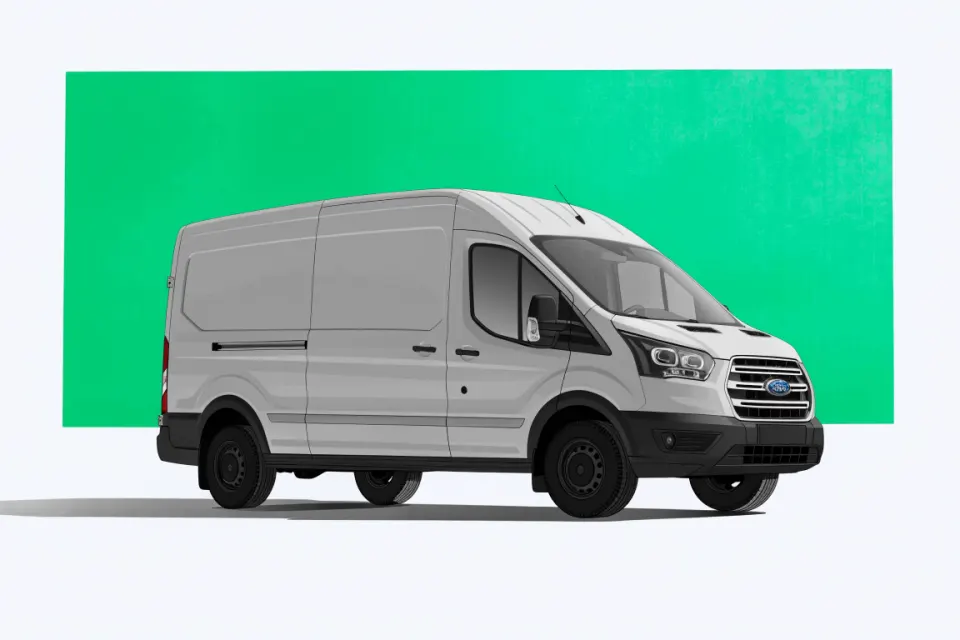
Ford E-Transit L4H3
Ford E-Transit Van Leader 350E L4 H3 Standard Range 68kWh 135kW/184PS
The Ford E-Transit Van Leader 350E L4 H3 Standard Range 68kWh 135kW/184PS has 145 miles of official range, a 755kg payload and 115kW rapid charging. List price £51,895 excluding VAT.
Electric · large van · L4 H3 · on sale
Dimensions
Price
Battery and range
| Usable battery | 68 kWh[1] |
|---|---|
| Gross battery | Not yet verified |
| Official range | 145 miles[4] (WLTP combined (2026.5 model year data)) |
| Energy use | No per-body figure. 25.5MY brochure gives WLTP electricity consumption 30.1-33.0 kWh/100 km for 350 Standard Range across all lengths/heights.[1] |
| Test cycle | WLTP combined (2026.5 model year data)[4] |
Load
Charging
Ownership
| Warranty | 3 years/100,000 miles vehicle warranty; 8-year/100,000 miles battery warranty[6] |
|---|
Ford E-Transit L4H3 price changes
No list price change recorded for the Ford E-Transit L4H3 since THRIVE first recorded its price on 17 September 2026.
List prices excluding VAT, from the manufacturer's own UK price lists. A date marked "recorded" is the day THRIVE took in a new price list that carried no date of its own.
Compare the Ford Transit with
- Citroën ë-Relay vs Ford E-Transit: price, payload, load space and size side by side
- Fiat E-Ducato vs Ford E-Transit: price, payload, load space and size side by side
- Peugeot e-Boxer vs Ford E-Transit: price, payload, load space and size side by side
- Vauxhall Movano Electric vs Ford E-Transit: price, payload, load space and size side by side
THRIVE verdict
A big-volume electric large van let down by one of the lowest payloads and ranges in its class.
This E-Transit's strength is cube, not carrying weight. Its 15.1m³ load area sits in the highest quarter of large vans, and the floor will take five Euro pallets or four UK pallets in a single row, or an 8x4 sheet flat between the arches. But payload of 755kg is in the lowest quarter of the class, well below the diesel Transit twin's 1,156kg, and below rivals like the Renault Master E-Tech (939kg) and Mercedes Sprinter diesel (965kg).
Range is the other compromise: 145 miles official is in the lowest quarter of electric large vans, against a class median of 235 miles, and well short of the Renault Master E-Tech's 242 miles or Citroën ë-Relay's 235 miles. The 68kWh battery is below median too, and peak DC charging of 115kW (around 37 minutes 10-80%) is below the class median, though still usable for a depot-charged, multi-drop day.
List price sits in the highest quarter of large vans, and after the Zero Emission Van Grant it undercuts the diesel Transit by only £4,300 - a gap that running-cost differences between home/depot and public charging will need to justify over the van's mileage. Towing is also weak at 750kg, lowest quarter of the class, against 2,800kg for the diesel twin. The 8-year/100,000-mile battery warranty is a genuine reassurance for fleets planning to keep vans long-term.
Best for
- bulky, light loads needing pallet capacity
- depot or home-charged urban and multi-drop routes
- fleets valuing a long battery warranty
Think twice
- payload is one of the lowest in the large van class
- official range trails most electric large van rivals
- towing capacity is weak next to diesel alternatives
Written 3 November 2026 from the verified figures on this page and the rest of the THRIVE database, and checked figure by figure before publishing. How we check
Other Ford Transit versions
| Version | Fuel | Payload | Range / economy | Price ex VAT |
|---|---|---|---|---|
| Ford Transit L2H2 diesel | Diesel | 1,479 kg | 33.6 mpg | £48,045 |
| Ford Transit L3H2 diesel | Diesel | 1,425 kg | 33.2 mpg | £48,845 |
| Ford Transit L2H3 diesel | Diesel | 1,437 kg | 32.1 mpg | £49,045 |
| Ford E-Transit L2H2 | Electric | 894 kg | 159 miles | £49,545 |
| Ford Transit L3H3 diesel | Diesel | 1,380 kg | 31.7 mpg | £49,845 |
| Ford E-Transit L3H2 | Electric | 910 kg | 159 miles | £50,345 |
| Ford E-Transit L2H3 | Electric | 852 kg | 152 miles | £50,545 |
| Ford Transit L4H3 diesel | Diesel | 1,156 kg | 29.4 mpg | £51,195 |
| Ford E-Transit L3H3 | Electric | 865 kg | 152 miles | £51,345 |
| Ford Transit L2H2 crew van diesel | Diesel | 1,293 kg | 32.5 mpg | £52,885 |
| Ford Transit L3H2 crew van diesel | Diesel | 1,239 kg | 32.1 mpg | £53,685 |
| Ford Transit L3H3 crew van diesel | Diesel | 1,194 kg | 31 mpg | £54,685 |
The 12 lowest-priced shown. Every length, roof and fuel side by side, with a configurator, on the Ford Transit page.
What fits in the load area
| Euro pallets (1,200 x 800mm) | 5, in a single row |
|---|---|
| UK standard pallets (1,200 x 1,000mm) | 4, in a single row |
| 8 x 4 sheets (2,440 x 1,220mm) | Lie flat on the floor, between the wheel arches |
| Pipe, timber or ladders | Up to 4.2m on the floor |
Worked out from the verified floor length 4,256mm, 1,392mm between the wheel arches, 2,025mm high. At the full Euro pallet count, the payload allows about 150kg per pallet. Counts use the width between the wheel arches for the whole floor, so they never over-count. Door openings are not in our data: check the rear and side door apertures before relying on a count. Goods stacked on a pallet can stand up to about 1,875mm tall, allowing 150mm for the pallet itself.
Electric or diesel?
How the Ford E-Transit Van Leader 350E L4 H3 Standard Range 68kWh 135kW/184PS compares with Ford Transit Van Leader 350E L4 H3 2.0L EcoBlue 130PS 6-speed manual RWD, the same body with the other powertrain, for a typical working day.
Workable, with planning
- Range. 100 miles a day is close to a planning range of about 102 miles: workable, but cold or heavily loaded days may need a top-up.
- Payload. The electric version carries 401kg less (755kg against 1,156kg).
- Towing. Braked towing: 750kg electric, 2,800kg diesel.
- Energy. Charging at a small-business depot costs about 13.4p a mile against 25.6p for diesel: roughly £3,050 a year less at 25,000 miles.
- Price. The electric version lists for no more than the diesel after the £5,000 zero emission van and truck grant.
When the diesel is the more practical choice
- Loads that use the last 401kg of the diesel's payload.
- Towing more than 750kg.
How this is worked out
- Planning range is 70% of the official 145-mile WLTP figure, allowing for winter weather and a full load.
- Energy use 0.469 kWh a mile: the usable battery divided by the official range.
- Diesel 165.48p a litre excluding VAT (DESNZ, week of 2 November 2026); the Ford Transit Van Leader 350E L4 H3 2.0L EcoBlue 130PS 6-speed manual RWD's official 29.4mpg.
- Electricity: 28.59p/kWh at a small-business depot (DESNZ, excluding VAT), 26.32p at home as the driver pays (Ofgem price cap), 65.83p on public rapid chargers (Zapmap, excluding VAT).
- 250 working days a year. List prices exclude VAT and options; running costs exclude servicing, insurance, tax and residual values.
Indicative only: a guide to whether electric is worth a closer look, not a quote. For whole-fleet costs see fleet charging costs and van break-even.
Electric and diesel compared: L4 H3
| Electric (this van) | Diesel | |
|---|---|---|
| Spec | Ford E-Transit Van Leader 350E L4 H3 Standard Range 68kWh 135kW/184PS | Ford Transit Van Leader 350E L4 H3 2.0L EcoBlue 130PS 6-speed manual RWD |
| List price (ex VAT) | £51,895 | £51,195 |
| Payload | 755 kg | 1,156 kg |
| Load volume | 15.1 m³ | 15.1 m³ |
| Range / economy | 145 miles | 29.4 mpg |
| Towing (braked) | 750 kg | 2,800 kg |
Both at a typical fleet specification, from each manufacturer's UK price list; sources are on each van's page. For running costs per mile, see the Fleet Cost Index and van break-even.
Alternatives worth considering
- Direct competitorCitroën ë-Relay Panel Van L3H2 3.5T Heavy Electric 270hp Automatic Enterprise£2,160 cheaper, 2.1m³ less load space, 90 miles more official range.
- Direct competitorRenault Master E-Tech LH35 Panel Van E-Tech Advance MY26£7,645 cheaper, 184kg more payload, 97 miles more official range.
- Combustion alternativeMercedes-Benz Sprinter 315 Van L4 H2 PRO RWDDiesel, 32.1mpg official, 210kg more payload, 0.4m³ more load space.
- Direct competitorFarizon SV L3 H3290kg more payload, 2.1m³ less load space, 89 miles more official range.
Chosen from published large vans in the THRIVE database with a similar load area; reasons compare verified figures only.
Head to head: Ford Transit vs Mercedes-Benz Sprinter · Ford Transit vs Renault Master · Ford Transit vs Farizon SV · Ford Transit vs Citroën Relay · Ford Transit vs Fiat Ducato · Ford Transit vs Peugeot Boxer
The Tuesday briefing
The week's fleet numbers and news, every Tuesday morning. Free.
One email a week. Unsubscribe in a click.
Sources
6 documents: Ford UK, Ford Motor Company Ltd (UK), GOV.UK (Office for Zero Emission Vehicles)
- Ford UK, retrieved 3 October 2026. Supports: load length (at floor), load width (maximum), load width between wheel arches, load height (maximum), overall length, overall width (excluding mirrors), usable battery, energy use, load volume, towing capacity (braked), rapid charge time. PDF page 11, VAN DIMENSIONS table, column 9 of 9 (L4 H3 RWD/AWD); Transit brochure MY 2025.5, March 2025 (the brochure ford.co.uk/vans-and-pickups/transit/pricelist links as current). E-Transit sits in the RWD/AWD columns of this combined Transit/E-Transit table (its E-Transit-labelled height rows fill only those columns); this row is not split by powertrain. | Link repointed 4 Nov 2026: Ford removed the 25.5MY brochure; linked to the archived copy of the same document. Original: https://www.ford.co.uk/content/dam/guxeu/uk/documents/brochures/cars/BRO-transit_van_25.5MY.pdf
- Ford Motor Company Ltd (UK), retrieved 17 September 2026. Supports: list price (excluding vat).
- GOV.UK (Office for Zero Emission Vehicles), retrieved 17 September 2026. Supports: zero emission van grant.
- Ford Motor Company Ltd (UK) - ford.co.uk Build & Price configurator (embedded spec data), retrieved 17 September 2026. Supports: official range, test cycle, gross vehicle weight, payload.
- Ford UK, retrieved 21 September 2026. Supports: ac charging (max).
- Ford UK (ford.co.uk), retrieved 17 September 2026. Supports: dc rapid charging (peak), warranty.
About these figures
- Specifications verified: 4 October 2026, against the manufacturer documents listed under Sources.
- Latest source added: 4 October 2026, the last time a figure on this page was added or corrected.
- Verdict written: 3 November 2026. It uses only the verified figures here and the THRIVE database; every number in it is checked against those figures, and it is rewritten only when they change.
Specifications vary by trim, engine, battery, length and roof height; these are for the Ford E-Transit Van Leader 350E L4 H3 Standard Range 68kWh 135kW/184PS as named, a typical fleet specification. Range is the official WLTP combined figure; real-world range in winter or fully loaded will be lower. Check the manufacturer's current price list before ordering. If a figure here has changed, tell us on our corrections page.